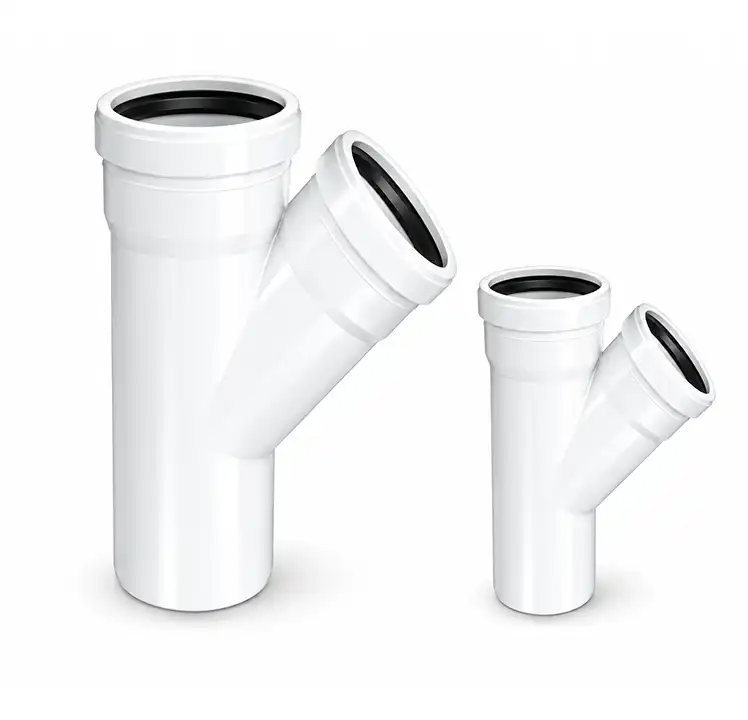
What you are installing: the range in brief
Our PVC pipes and fittings range is a waste water system in uPVC. The PVC Type 1 waste water pipe is supplied in Ø50, Ø75, Ø110 and Ø160 mm, in lengths from 150 mm to 6000 mm depending on the diameter, in white. Around the pipe, the range covers 45° and 90° single and double branches, sliding sockets (50-250 mm), reductions, push-fit end caps (50-160 mm), cleaning access fittings (110-200 mm) and 45° and 90° S-siphons in 110 mm.
PVC pipe is much lighter than metal pipe, which makes transport and installation easier, and it resists corrosion and decay — the two reasons it is widely used for plumbing and sewage work, as covered in our guide to the advantages and limits of PVC.
Slope: the one value you must take from the project specification
A drainage run only works if it falls continuously towards the outlet: standing water collects solids, and a section that sags or runs uphill will block. Plan the fall of every horizontal run before you fix anything, and check the finished run along its whole length, not only at the ends.
Our technical catalogue does not publish a slope (gradient) value for PVC drainage pipe, so this article does not invent one. Take the required fall from your project specification or local building code for the pipe diameter you are installing, and if the specification is silent, confirm the value with the project engineer before the pipework is closed. Designing the fall from a generic internet figure is one of the common mistakes below.
Joints and fittings: match the fitting to the job
PVC fittings, couplings and elbows connect pipes at different angles and configurations, which makes installation quicker and more secure even in complex layouts. In our range, choose the fitting by function:
- Direction and branches: 45° and 90° single branches join one lateral line to a stack or main run; double branches join two. A 45° branch turns the flow more gradually than a 90° branch.
- Diameter changes: reductions step the run down between diameters (in our range, from 50x50 up to 250x160 mm) instead of forcing a joint that does not fit.
- Movement and repair: a sliding socket (50-250 mm) is an expansion coupling that also makes a section of pipe easier to replace later.
- Testing and closing ends: push-fit end caps (50-160 mm) close a pipe end during testing or permanently.
- Future access: a cleaning access fitting (110-200 mm) leaves a removable opening for rod and camera access — fit one where a future blockage would otherwise mean cutting the pipe.
- Traps: 45° and 90° S-siphons (110 mm) provide the water seal at basin, bath and WC connections.
Common mistakes that cause leaks and blockages
Most drainage failures trace back to a short list of avoidable errors:
- Wrong or reversed fall: a run fixed before its slope was planned, or a sagging section that holds water. Check the fall along the whole run before closing.
- Using PVC where it does not belong: PVC is not resistant to high temperatures, so do not use it for hot water lines — PPR-C pipe or metal is the suitable choice there. It is also sensitive to high pressure and physical shock, so it is not for high-pressure lines.
- Leaving PVC exposed outdoors: PVC is not UV resistant; in long outdoor exposure it can fade or crack. Use a UV protective coating or sleeve for outdoor runs, or route them out of direct sun.
- Ignoring chemical resistance: PVC is not resistant to certain aggressive chemicals. Check chemical resistance before using it where aggressive chemicals are discharged.
- No access for cleaning: a layout with no cleaning access fitting turns a simple blockage into pipe cutting.
- Closing the work before testing: run water through every branch and check every joint before the pipework is covered. A joint that is dry on the outside after a full test is the standard to close on.
Installation checklist
Before you close any PVC drainage work, work through these checks:
- Slope: fall confirmed from the project specification or local code for each diameter, and checked along the whole run — no sags, no reverse sections.
- Fittings: branch angle, reductions and siphons match the layout; every diameter change uses a reduction fitting.
- Access: at least one cleaning access fitting where a blockage would otherwise require cutting.
- Limits respected: no hot water duty, no high-pressure duty, outdoor runs UV-protected.
- Test: full water test of every branch, every joint inspected dry, before covering.
Request a quote
Tell us the diameters, lengths and fittings you need through the quote request form, or contact our export team for the PVC price list and the full drainage range.