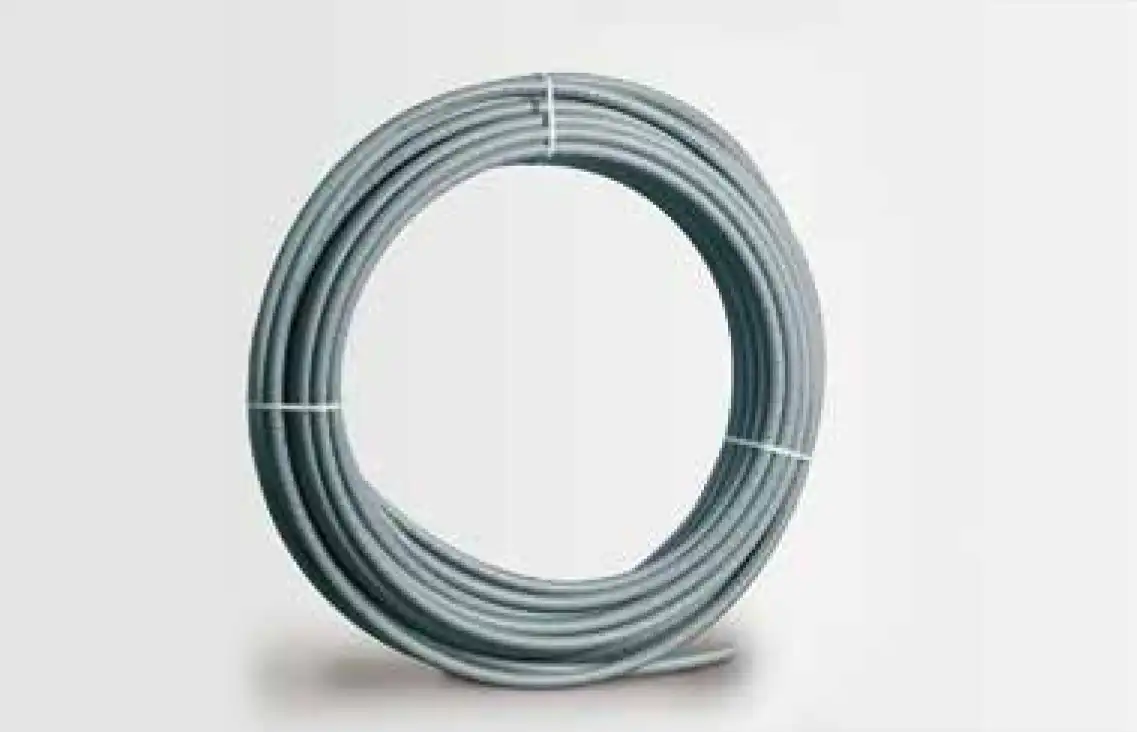
Two pipe materials, two joining methods
Our range includes two plastic pipe systems for water installations: PB pipes and fittings, made from polybutylene, and PPR-C pipes and fittings, made from polypropylene random copolymer (Type 3). They are not interchangeable versions of the same pipe: they differ in diameter range, in the forms they are supplied in and, most importantly, in how the joints are made.
PB joints in our range are push-fit: sockets, elbows, tees and reducers, typically in Ø15–50 mm, push together, with brass threaded adapters where a run meets a threaded outlet. PPR-C joints are welded: pipe and fitting are heated on a welding machine at 260 °C ±10 °C and fused into a single piece, as described in our PPR welding guide.
Side by side: the published range data
The table compares only what is published for each system in our range and technical catalogue. Where a value is not published for a system, the cell says so instead of borrowing the other system's figures.
PB and PPR-C in our range: published data
| PB | PPR-C | |
|---|---|---|
| Material | Polybutylene (PB) | Polypropylene random copolymer (Type 3) |
| Pipe sizes | Pipes 15, 22 and 28 mm | Ø20–110 mm |
| Supplied as | Straight bars 5.8 m; coils: Ø15 in 100 m, Ø22 in 50 m, Ø28 in 25 m | Straight pipes; aluminium-foiled pipe Ø20–63 mm |
| Joining | Push-fit fittings; brass threaded adapters (compression + thread) | Polyfusion (socket) welding at 260 °C ±10 °C |
| Pressure classes | Not published in our range data | PN16, PN20, PN25; Blue Fusion PN20+ |
| Published system rating | Not published in our range data | 20 bar at 20 °C; 10 bar at 90 °C; operating temperature 70–90 °C |
When PB is the practical choice
Choose PB when the job matches what the range is built for:
- Small diameters only: the whole PB range — pipes, sockets, elbows, tees and reducers — covers 15 and 22 mm.
- Long runs with fewer joints: coil pipe in 25, 50 and 100 m lengths covers long distances from a single coil, where straight pipes would need a joint at every bar length.
- No welding machine on site: push-fit joints are assembled by hand, so no welding machine, heating heads or welding power supply is needed.
- Threaded outlets: brass threaded adapters in the PB range connect the run to threaded fittings and outlets.
When PPR-C is the documented choice
Choose PPR-C when the project needs published pressure and temperature data or larger diameters. The technical catalogue rates the PPR-C system at 20 bar at 20 °C and 10 bar at 90 °C, with an operating temperature of 70–90 °C, and the range runs from Ø20 to Ø110 mm in the PN16, PN20 and PN25 pressure classes.
For hot lines where expansion matters, reinforced options exist in the same system: glass-fibre composite pipe reduces thermal expansion, and the Blue Fusion PN20+ series and PN25 composite (GF) pipe are the reinforced choices covered in our pressure-class guide. The welded joint is the trade-off: it needs a welding machine, the published heating times for each diameter, and a pressure test before the installation is closed.
Selection checklist
Before you specify either system, work through these checks:
- Diameter: does the run stay within PB pipe sizes 15, 22 and 28 mm, or does it need diameters in the PPR-C range (Ø20–110 mm)?
- Documentation: does the project specification require a published pressure/temperature rating? In our range, that documentation exists for PPR-C; for PB, request the available documents first.
- Joining on site: is a welding machine and a trained welder available (PPR-C), or must joints be made without welding equipment (PB push-fit)?
- Run length and form: do PB coil lengths (Ø15 in 100 m, Ø22 in 50 m, Ø28 in 25 m) simplify the layout, or are straight bars the practical form?
- Fittings and outlets: list the elbows, tees, reducers and threaded adapters the layout needs and confirm each one exists in the chosen system's range.
- Testing: plan a pressure test before the installation is closed, whichever system you choose.
Request a quote
Tell us the system, diameters and quantities you need through the quote request form, or contact our export team for the price list and the technical documents available for each range.