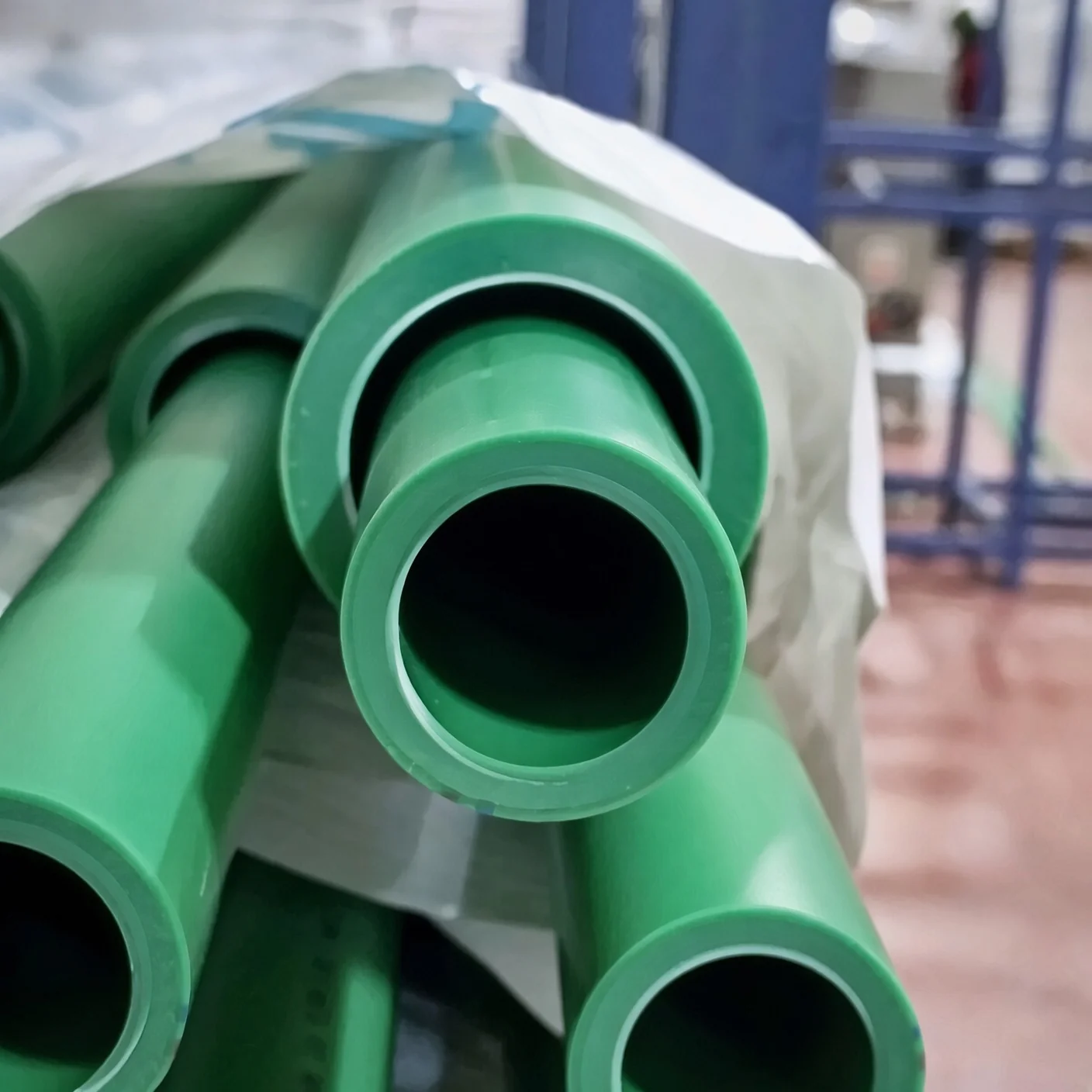
What PN means on a PPR-C pipe
PN is the nominal pressure class marked on the pipe. It indicates the pipe's pressure rating under specified conditions, and the allowable pressure decreases as the water temperature increases. A class with ample reserve on a cold-water line therefore has less reserve on a hot-water line.
Our PPR-C pipes and fittings are made from polypropylene random copolymer (Type 3). For the system, our technical catalogue states an operation pressure of 20 bar at 20 °C and 10 bar at 90 °C, and an operating temperature of 70–90 °C.
The PPR-C pipes and fittings range covers the PN16, PN20 and PN25 classes, glass-fibre composite (GF) and aluminium-foiled versions, and the Blue Fusion PN20+ series. Pipes are available from Ø20 to Ø110 mm; aluminium-foiled pipe from Ø20 to Ø63 mm.
Wall thickness by pressure class (Ø20–110 mm)
At the same outside diameter, PN20 pipe has a thicker wall than PN16 pipe. The table lists the wall thickness of every pipe type in the range, as published in our 2026 technical catalogue.
Wall thickness (mm) by outside diameter and pipe type
| Outside Ø (mm) | PN16 | PN20 | PN20 composite (GF) | PN25 composite (GF) | PN25 aluminium-foiled | Blue Fusion PN20+ |
|---|---|---|---|---|---|---|
| Ø20 | 2.8 | 3.4 | 2.8 | 3.4 | 3.4 | 3.4 |
| Ø25 | 3.5 | 4.2 | 3.5 | 4.2 | 4.2 | 4.2 |
| Ø32 | 4.4 | 5.4 | 4.4 | 5.4 | 5.4 | 5.4 |
| Ø40 | 5.5 | 6.7 | 5.5 | 6.7 | 6.7 | 6.7 |
| Ø50 | 6.9 | 8.4 | 6.9 | 8.4 | 8.4 | 8.4 |
| Ø63 | 8.6 | 10.5 | 8.6 | 10.5 | 12.0 | 10.5 |
| Ø75 | 10.3 | 12.5 | 10.3 | 12.5 | — | 12.5 |
| Ø90 | 12.3 | 15.0 | 12.3 | 15.0 | — | 15.0 |
| Ø110 | 15.1 | 18.4 | 15.1 | 18.4 | — | 18.4 |
How to choose the class: five checks
No single class suits every project. The right choice depends on the water temperature, the line pressure, the line length and how the line is used. Work through these checks before you specify the pipe:
- Maximum water temperature. The hotter the water, the lower the allowable pressure: the system is rated 20 bar at 20 °C but 10 bar at 90 °C. Hot-water lines need the correct class and/or a reinforced pipe.
- Line pressure. Compare the operating pressure of the line with the reserve the class offers at the line's temperature. A wrong choice shortens service life and increases the risk of deformation and leaks at high temperature and pressure.
- Hot water: is PN20 enough? It depends on the project. Depending on temperature, line pressure, line length and usage, PN25 composite (GF) pipe or another reinforced pipe may be preferred to PN20 pipe.
- Line length and expansion. PPR-C expands more than metal pipe, and linearly: the coefficient of linear thermal expansion is 1.5·10⁻⁴ 1/K (average, 20–90 °C). On long hot lines, control it with reinforced pipe, correct clamping and an expansion allowance. Glass-fibre composite pipe reduces thermal expansion and gives a more stable line with less sagging; aluminium-foiled PN25 pipe can be preferred for long runs where expansion is critical. Its preparation method (scraping, etc.) depends on the product.
- Drinking water and exposure. PPR-C is widely used in drinking-water lines; the green PPR raw material used for our PPR pipes and fittings is WRAS approved (BS 6920-1:2014). Prolonged direct sunlight can damage PPR-C, so protect outdoor lines with insulation, a sleeve or a duct.
Worked example: expansion of a hot line
With the raw-material coefficient of 1.5·10⁻⁴ 1/K, a 10 m standard PPR-C line that heats up from 20 °C to 70 °C changes length by 10 m × 50 K × 1.5·10⁻⁴ 1/K = 0.075 m, i.e. 75 mm. Movement of this size is why long hot lines need reinforced pipe, clamp spacing chosen for the diameter and temperature, and an expansion allowance.
Before the line is covered: pressure test
A pressure test is mandatory and must be carried out before the pipe is covered with plaster or screed. The test pressure depends on the project and the applicable standard; it is typically above the operating pressure, and the project specification should be followed.
Request a quote
Send us the diameters, pressure classes and quantities for your project through the quote request form, or contact our export team for a recommendation based on your line temperature and pressure.